Click image to enlarge
Growth, Resources, and Structural Divergence in 2025
Resources, Risks & Realities: Who's Growing and Who's Stalling
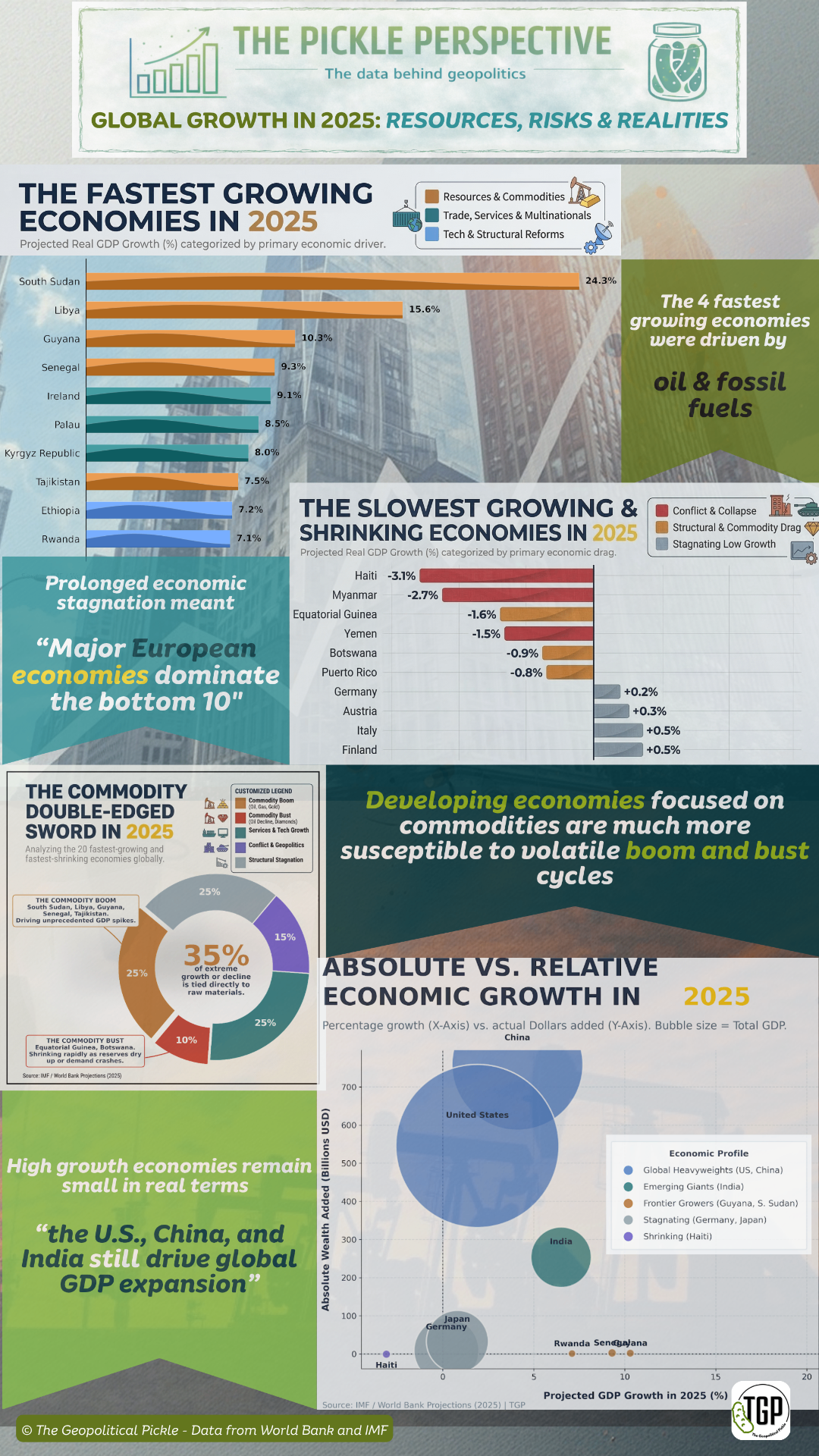
Explore the Data ↓Global economic performance in 2025 highlights a widening divergence between resource-driven growth and structural stagnation. The fastest-growing economies are overwhelmingly concentrated in states experiencing commodity windfalls, particularly in oil and gas. South Sudan, Libya, Guyana, and Senegal all benefit from new or expanding hydrocarbon production, driving rapid headline growth rates. Yet this same dependence exposes the volatility of resource-led development. In countries such as Botswana and Equatorial Guinea, declining commodity prices or depleting reserves have contributed to economic contraction.
This dynamic underscores the "resource double-edged sword": commodities can generate rapid expansion but also amplify vulnerability to external shocks. Across both the fastest-growing and fastest-shrinking economies, a significant share of extreme outcomes is directly linked to resource cycles.
However, headline growth rates alone obscure global economic influence. Smaller economies may record double-digit growth, but their contribution to overall global output remains limited. By contrast, large economies such as the United States, China, and India continue to drive the bulk of global GDP expansion. Among these, India stands out as the fastest-growing major economy, while U.S. growth remains comparatively subdued.
At the same time, several advanced European economies including Germany, Austria, Italy, and Finland are all experiencing prolonged periods of economic stagnation. Weak growth in these traditionally strong industrial economies points to deeper structural challenges and highlights the increasing importance of competitiveness in shaping long-term economic trajectories. This has repeatedly been highlighted as a priority area for the EU over the last few years, however evidence suggest that any reform has not yet had the downstream effect.
Data: World Bank (2025); IMF World Economic Outlook (2025); author visualisation.
The Pickle Perspective — Geopolitics through maps and data.