Click image to enlarge
NATO Expansion: An Evolution Over Time
NATO Enlargement and the Changing Security Geography of Europe
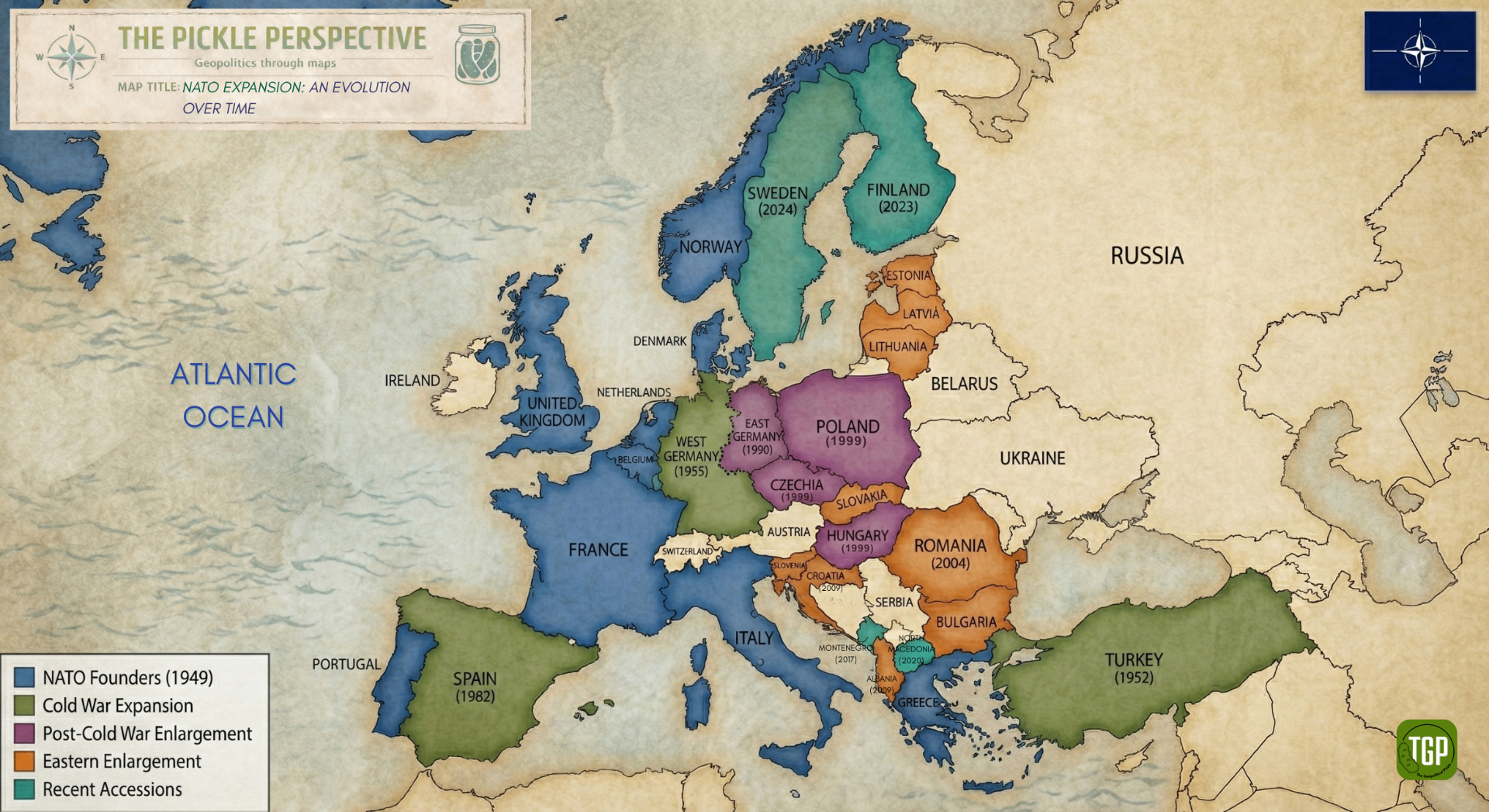
NATO was established in 1949 as a collective defence pact designed to anchor the United States within the security architecture of Western Europe and deter Soviet expansion. During the Cold War, membership remained geographically limited, reflecting the division of Europe into two opposing blocs. The collapse of the Soviet Union transformed this strategic landscape. From the late 1990s onward, successive waves of enlargement extended NATO's security perimeter eastward, incorporating Central and Eastern European states that had previously been within the Warsaw Pact.
This expansion altered the military geography of the continent, shifting NATO's frontier closer to Russia and embedding former buffer zones within a collective defence framework. While enlargement was driven by the security preferences of applicant states, it has remained a central point of contention in Russia's strategic narrative.
Russia's full-scale invasion of Ukraine in 2022 reinforced rather than reversed this dynamic. Longstanding neutrality in Northern Europe gave way to rapid policy change, with Finland joining NATO and Sweden following shortly thereafter. The alliance's northern flank now forms a contiguous security space from the Arctic to the Baltic, reshaping regional deterrence and operational planning.
NATO enlargement therefore reflects not a single historical moment, but an ongoing reconfiguration of European security driven by threat perception, alliance politics, and shifting strategic geography.
Data: NATO official membership records; historical accession timelines; author visualisation.
The Pickle Perspective — Geopolitics through maps and data.